
SCIENTIFIC FIREARMS TRAINING: THE NEW FRONTIER
If you really want to understand and gain high-end performance, you need to accurately be able to understand, describe, and communicate that performance.
Written by Ron Avery
If you have ever watched truly world-class athletes perform their skills, you can appreciate that their seemingly effortless performance is the result of dedicated training, correct coaching and mental focus.
We marvel at their skills and we wonder how they do it. Maybe, we even start to compare ourselves to them and imagine ourselves performing at that level. What would it take? How would we do it?
For many years I have both participated in and studied world-class performance with firearms. Both as a competitive shooter and as a cop working the street or rural areas, I knew I wanted to be better, and I diligently searched, researched, and innovated new ways of thinking about training and performance.
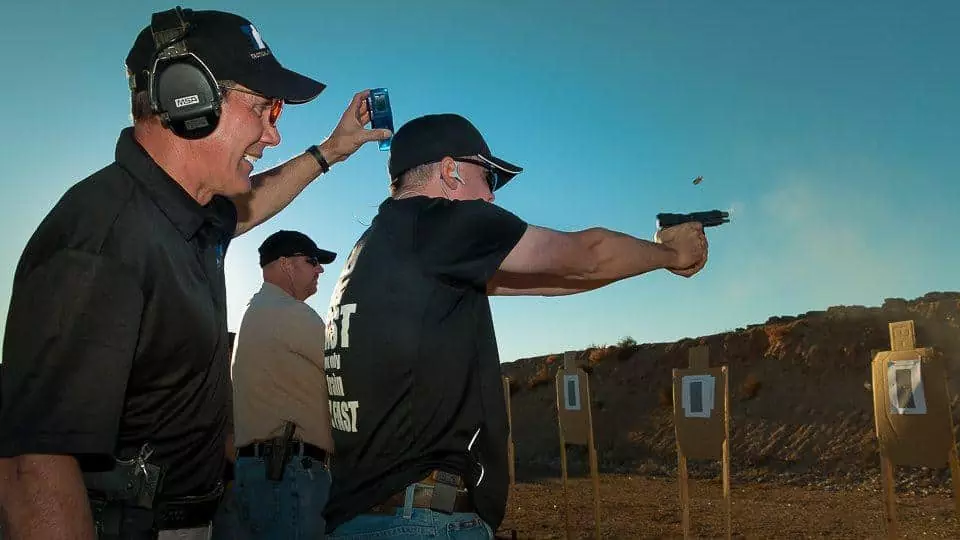
After over 30 years of conducting and studying training, I have repeatedly come to the conclusion that we really need to use the existing sciences to explain what we do and how we do it. We also need to do it in a form that is reasonably objective.
Being able to describe in detail what we do in terms of proprioception, kinesiology, kinesthetic awareness, muscle memory, visual processing, mental processing, and biomechanics greatly aids in being EXACT in what we are actually talking about.
Here is where I feel the world of firearms training is lacking. We tend to brand things as “tactical this or that,” or use clichés to describe performance instead of being exact as to how we actually create our performance. This is simply inefficient and leads to many performance errors that hinder progress.
For example, I have been using kinesthetic awareness (KA)─which is a sense─ to teach use-of-force skills for over 30 years. I still have people that want to call it “muscle memory,” which is, in essence, a learned reflex that is a byproduct of kinesthetic awareness.
Using kinesthetic awareness correctly, with proper coaching, will greatly increase your conscious and subconscious understanding, and your internalization and execution of a skill, in a much shorter time then not using it. This has been proven in my research and after-action reports time and time again.
Most of the problems I see in shooting are because the student understanding and awareness of how his body and brain actually works to control performance.
If you really want to understand and gain high end performance, you need to accurately be able to understand, describe, and communicate that performance, and then be able to teach it with a high degree of detail.
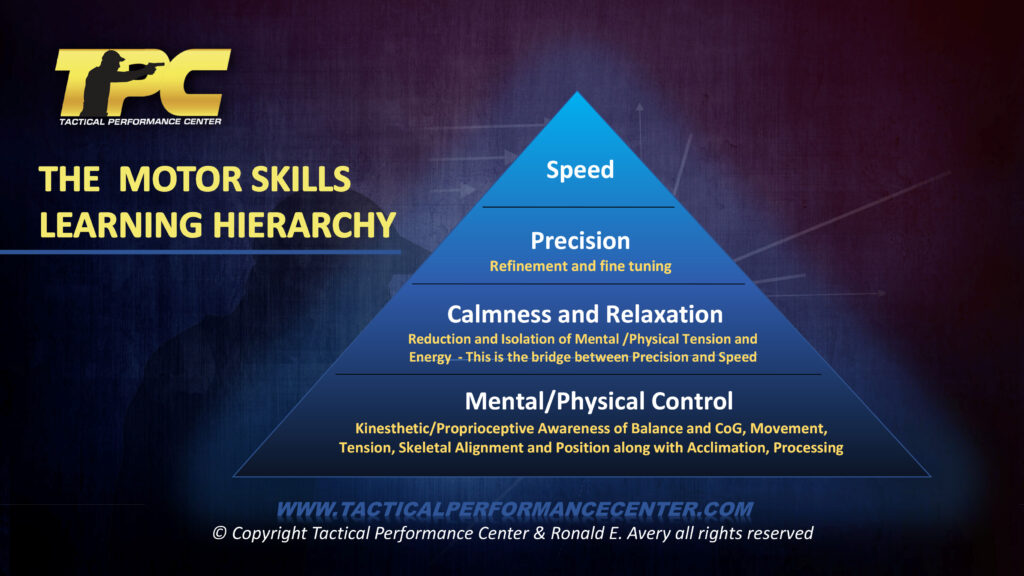
There is a skills hierarchy that also must be understood and applied if you want this type of performance.
This higher performance requires a higher level of trainer and student education about the behavioral and motor learning sciences, together with the application of that knowledge to both firearms and use-of-force training.
This is not to say that we must all become scientists, or that academia replaces knowledge gained by experience in the real world. I believe that experience is a wonderful feature that augments training and shooting. So is talent.
However, we did not get to the moon on experience alone. We had to use creative applications of what we knew to create new ways of thinking that allowed us to go farther than we ever had before. Scientific, creative application of knowledge will take you farther than experience alone can. We use both to elevate performance.
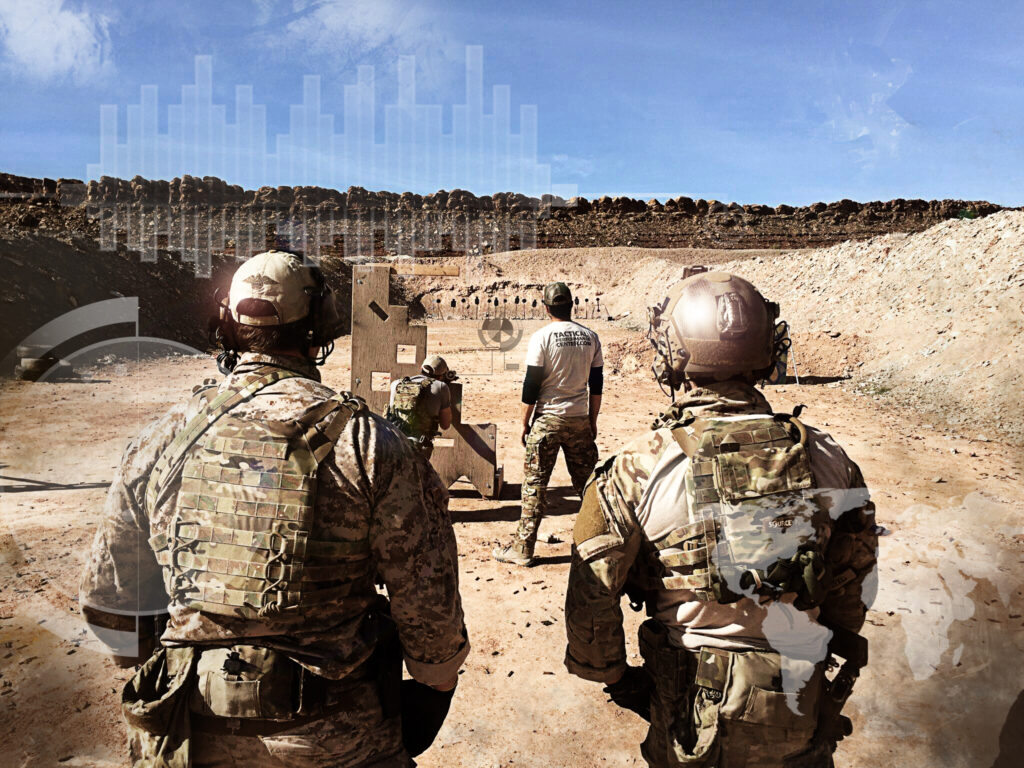
I offer this same parallel when it comes to use-of-force training. Understanding and using scientific principles, terminology, and applications that accurately describe what we do in firearms training will make you a better trainer and performer. The results will be more detailed and precise, and will allow us to better understand and absorb it. We can also reduce ego, branding, worn-out clichés, and outmoded thinking, and move into an era where we can learn what it really takes to bring ourselves and our students up to a high level of performance and execution under highly stressful conditions.

You can also design drills and exercises that precisely target the performance you seek to improve, instead of simply shooting courses of fire or some drill you saw on the internet.
Using this methodology, I have brought many shooters to high levels of performance in much shorter timeframes than my earlier efforts. Back then, we didn’t know nearly as much about how to train, think, and perform as we do now. I relied on my natural talents, but I really did not understand how I did things until I took the time to do my homework in the other sciences.
I still feel I have a long way to go as a student and as a performer. But I am confident that the scientific approach to training and performance is the only way to go if you truly want to excel as a trainer or a performer. I know I use it to the exclusion of other approaches, and I am constantly learning more and more about how to apply scientific methods to my training to raise both my own and my student’s performance level. The better that I can understand, describe. and explain performance, the better I can teach it to myself and others. And that is what we are all after.
There is a glut of pseudoscience being passed off as real science when it comes to training, and it is truly a buyer-beware market out there.
I believe in using scientific terminology for the sake of being accurate in what I am trying to do, not to impress or baffle the student with smoke and mirrors. It is not necessarily simple but, then again, I don’t think any of my students are stupid either. If you want to perform at a higher level, you are going to have to step up to a higher level of education, application and execution.

Ron Avery – the man behind the doctrine of “Reactive Shooting Science” and co-founder of Tactical Performance Center
Ron Avery was the co-founder and director of training for The Tactical Performance Center (TPC). A former police officer, as well as a martial artist, Ron brought that experience into the training environment. He was internationally recognized as a researcher, firearms trainer and world-class shooter, and his training methodology has been used by hundreds of agencies and thousands of individuals across the US and internationally. He was a weapons and tactics trainer for handgun, carbine, precision rifle and shotgun, as well as advanced instructor schools, defensive tactics, low light tactics and officer survival.
Ron passed away on February 23, 2019, leaving a legacy of contributions to police firearms and defensive tactics training.
